


The so-called genie of the gambling bottle was released in 2018, when the Supreme Court determined that the prior federal ban on sports betting was unconstitutional. 39 states have since legalized and expanded their sports betting offerings, including online and in-app. Then came the prediction markets, platforms in which users could place bets not just on sports but on anything — the number of views Mr. Beast’s next YouTube video will get, whether there will be foreign intervention in Gaza by a certain date. The Polymarket website has an entire tab titled “Iran” positioned between Esports and Finance. Americans today are now more likely to gamble than they are to have finished a single book in the last year. Fortune reported this summer that gambling is now America’s favorite pastime: Americans spend more on sports bets than movies, arts, museums, and music combined.
Recent data from the Institute of Family Studies is equally bleak. 98 percent of young men gamble, watch porn or play video games, the majority participating in some combination of the three. 1 in 8 young men do all three every day. Does gaming deserve to be considered equal to porn or gambling as a vice? Probably not in a vacuum. That many young men at least occasionally watch porn or gamble isn’t inherently some frightening fact in a vacuum, either. But combined, they point to a new cultural reality: our daily lives are increasingly structured as though we are in a casino.
The casino-ification of our culture is not limited to the proliferation of literal gambling. All of our culture, through the lens of our phones, has transformed into this 24/7 carnival that transcends space and time. There are no clocks, no holidays, no traditions. There is instead the constant, glimmering lure of the chance of fulfillment. And here still, the house always wins.
It’s funny that this has come at a time when young people are described as being particularly afraid of risk. Well, maybe not funny. Maybe it’s actually one in the same. We’re afraid of the risk of emotional vulnerability, of having our hearts broken, of getting drunk and having fun because we’ve already replaced these risks with this endless game of digital chance. And at the core of this, too, is a sense of fear.
“Gambling converts time into a narcotic,” wrote philosopher Walter Benjamin in 1920. In Benjamin’s German, experience is separated into two categories: Erfahrung vs. Erlebnis. The former describes experience in the cumulative sense, a long-term wisdom shared and fostered by time and community. The latter describes experience in the immediate—a moment, an event. The gambler’s life is dictated entirely by erlebnis. Every previous bet is irrelevant when each new hand presents a fresh opportunity to win. Gambling is an ancient tradition, but one that—like all things—was transformed by the emergence of industrial labor and modern capitalism.
And even as gambling came to represent the fractured relationship between work and capital, Benjamin still identified a certain pleasure in gambling. In The Arcades Project, Benjamin described a gambler fresh off a win:
“He leaves the Palais-Royal with bulging pockets, calls to a whore, and once more celebrates in her arms the communion with number, in which money and riches, absolved from every earthen weight, have come to him from the fates like a joyous embrace returned to the full. For in gambling hall and bordello, it is the same supremely sinful delight: to challenge fate in pleasure… Thus in gambler and prostitute that superstition which arranges the figures of fate and fills all wanton behavior with fateful forwardness, fateful concupiscence, bringing even pleasure to kneel before its throne.”
Digital gambling is no longer a communion with number but a communion with algorithm. Swiping is itself a form of gambling, steeped in a sense of superstition. We do it because we think all of that has yet to come. We swipe because gratification is just a few Reels away. Just a few more and we’ll see something worth talking about, something that makes us laugh, something that makes all the time we’ve put into it seem at least partially worth it. And just as the slot machine every so often doles out a minor win, so does Instagram.
Our approach to the algorithm is itself much like that of a slot machine, too. People trying to make it big on TikTok speak of the algorithm with the same superstition one does the machine. There is a blind faith that if you post enough, eventually, something will go viral. The exact content doesn’t matter. Eventually, you’ll hit triple cherries. Those three spinning discs lined with symbols are called a reel, after all. Even AI is, in many respects, akin to pulling a lever and trying one’s luck to see what emerges. That air of superstition persists: large language models are approached by many as though they are divining truth from the ether.
Maybe some of this is merely a problem of medium—old attitudes being incompatible with new methods. Were someone going to the casino every day, we would patently see it as a problem. But there are plenty of people who have one drink a day, or who eat dessert every night, or who wake up and have a single cigarette with their coffee, who we do not label as doing something entirely degenerate. Mildly harmful to their health, maybe, but a reasonable enough vice to fit into one’s day with few if any side effects. Could gambling, in this newly digitized form, be the same? Is it really so bad if someone places a bet or two a day of maybe a few bucks a piece?
That may describe some players. According to DraftKings Average Results from August 30th, 2026, the average net winnings for Daily Fantasy players over the last 30 days is $-9, while the median is $0. Other studies report that the average bet for men ages 21-34 is $58. Meanwhile, according to NerdWallet, the average sports better has spent $3284 in the last twelve months. Of course, with something like gambling, these figures are likely to be skewed by those gambling significantly larger sums — the median annual gambling spend is $750. On Polymarket, meanwhile, the average bet is $6.50, but 11 percent of users made 1000 trades or more over a six week period.
The majority of gamblers are not in any way financially improving their lives, even they aren’t all entirely damaging them, either. So what do we get from all this? What is the draw? Dopamine, yes, but also cortisol. While the concept of “cortisol addiction” isn’t scientifically grounded, it does seem to explain how many people navigate their online lives. Betting apps are a manifestation of a relationship we’ve already developed with our phones. They are, frankly, another thing to do and attempt to find fulfillment in. They are an escape from the things our phones tell us need escaping.
Through our phones, the Internet and the news constantly reinforce a belief in our heads that we are living through the worst time, that our safety and our wellbeing and our futures have never been as bad as this. When disasters occur, they are often broadcast to us in full color, from a variety of angles and perspectives. Here’s a video of a devastating flash flood from the top of a hill. Here’s another from the third floor of a building that will soon be swept away. Here’s a shooting in a mall. Here’s a stabbing in Times Square. Watch them over and over again on a loop.
The casino has made these events part of our own immediate experience even if entirely disconnected from our own lives. It is a machine that encourages rabid nihilism as the only natural perspective. It encourages it because it feeds on it to survive. If gambling is a narcotic of time, one that prioritizes the immediate experience above history, wisdom and accumulated knowledge, then this is precisely what our digital experience has become. Each swipe is a new opportunity for justification and fulfillment, absent of everything we have seen before. Gambling, said Benjamin, invalidates the standards of experience. The casino imbues everything with an element of shock: “For the bourgeoisie, even political events were apt to assume the form of occurrences at the gambling table.”
I can’t help but also think of the Lindsay Clancy case. Despite the trial in no way serving to prove whether Clancy murdered her three children but rather solely whether she experienced psychosis when she did it and is therefore criminally responsible, there is a not insignificant mass of women who believe she is completely innocent. They believe it must be an elaborate set up by her husband, who either killed the children himself or brainwashed her into doing it. They believe a mother could not possibly experience such depths of mental illness as to do something so awful, but also that her mental illness is itself the result of failures by everyone from her husband to the state of Massachusetts. The latter part of that may well be true. But they believe all of this because they are consuming the trial as content. They are finding entertainment value from it. Now, Nancy Grace has been on television for over thirty years. True crime isn’t new. But it is, undoubtedly, more popular than ever. Through podcasts and YouTubers who do their makeup while describing torture and TikTok, it all feels far more immediate.
The gender war is inextricably bound to the true crime boom, especially in the Clancy mistrial. It is an obvious place upon which women in particular can place their anger and feel justified, which it often is. But the most common narrative of true crime is that men kill women, and women who kill do so because of men. Meanwhile, violent crime is at an all time low, and men are themselves far more likely to be victims of it. But with the popularization of true crime narratives that do not fit this broader trend, it is easy to be convinced that the world is not only an unsafe place for women but increasingly so. And with all of this, people are now consuming true crime in this casino-ified form. It is a swipeable form of addictive, risk-based digital entertainment.
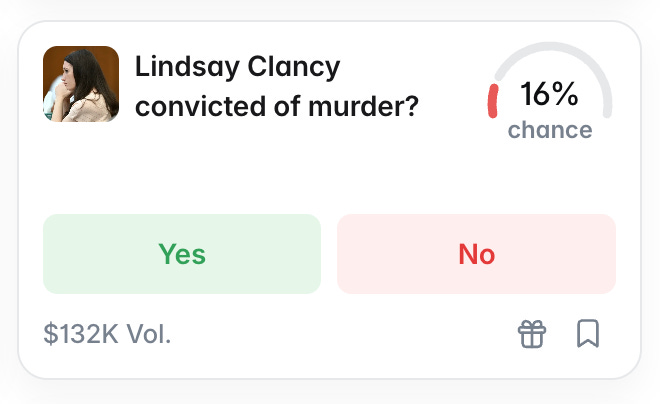
Whether Lindsay Clancy would be convicted was a trending trade on Polymarket.
One of the most confounding features of contemporary life is this sense that the things we have always done are no longer feasible. They are instead approached with fear, bordering on terror. Not quite the terror we feel when watching videos of a flash flood, but maybe not quite that different, either. Dating. Sex. Having a child. If not for you at least for someone you know, someone you scroll past on TikTok. There, both the flash flood video and the buzzy true crime vy for attention equally. And both work to tell us that the things everyone has done before us can no longer be done by us.
The algorithmic casino is both the machine and the sedative of this fear. It has made this fear somehow feel good, productive. There is a subconscious pleasure in engaging with it. The sense of dystopian tragedy it distills upon us moreover makes our own apathy more palatable. Who cares that we’re losing thousands on digital sports betting when the world is ending? If not thousands of dollars on bets then thousands of hours scrolling. What’s it all for, anyway? “The best lack all conviction while the worst are filled with passionate intensity.”
My own optimism for the future at times seems radically opposed to the vision of the world I lay out here. I am painting a portrait of a culture burdened by digital vice and misery. But my optimism persists in the fact that so much of this remains a matter of perception and maybe, unpopularly, personal choice. We don’t have to keep pulling the lever. Someday we can choose to emerge from the casino and be blinded by the sun.
Going to sound like an old fart (I'm a millennial) but I even think gambling used to be better. The thing I always loved about physical real casinos was talking to random interesting strangers while getting free drinks. I once saw a lady drop $400 each on 5 rounds of roulette, lost all $2000 and stormed out of the casino cursing. The comedy and tragedy of the situation was a learning moment. I'm afraid the nature of online gambling hides all that shame and social costs. Another symptom of our time.
I share your optimistic sentiment. Hedonism is nothing new and though it may be more accessible than in the past, other good things are more accessible too like free books and great writing, contacting your friends and loved ones across the world, nutrition to a level never seen before by humanity, and many more examples.