


Hello and welcome to Many Such Cases.
Before I get started: Before I get started: thank you to everyone who offered their well wishes for my father. I don’t really have a ton of updates, but he remains in a rehabilitative hospital and is improving daily. I am so appreciative of everyone who has messaged me, and all the grace I’ve been given as a writer here. I know it’s “just” a newsletter, but I take the work here and this audience seriously.
Also:
Playboy launched a Substack today. I’ll be helping curate longform features from the archives, pictorials and new fiction and nonfiction alike. I really hope you’ll subscribe! For starters, we have this gorgeous gonzo reportage by Allie Rowbottom on the AVN conference.

Surely you’re aware that Valentine’s Day is four days away. I love Valentine’s Day. Yes, sure, it is a commercialization and commodification of love, but the price is a box of chocolates. We’ll manage! You can extract all the fun out of it, or you can embrace it for the kitschy tradition it is. Valentine’s Day or otherwise, I’m going to go for the latter. Be miserable about love some other day.
It really doesn’t require much depth or grand gestures. Valentine’s Day has its formulas, and they are meant to be followed. Buy a bouquet of flowers. Cut a heart out of a piece of pink construction paper. Have sex. It’s not all that complicated.
But something to question is how a holiday designed to sell us on love is responding to an increasingly single, sexless culture. That element is less fun.
Intimacy brand Slick’s shared their recent report The Sex Recession: Intimacy and Its Decline with me, and it is a rather thoughtful compilation and analysis of the data myself and others have been citing on the problem. “Across multiple longitudinal studies, reported sexual activity has decreased steadily over the past 15–20 years,” the report reads, citing data from the General Social Survey. “This decline is most pronounced among adults under 40, with younger cohorts reporting fewer sexual encounters per year than previous generations at the same age. The trend predates the pandemic and does not rebound afterward.”
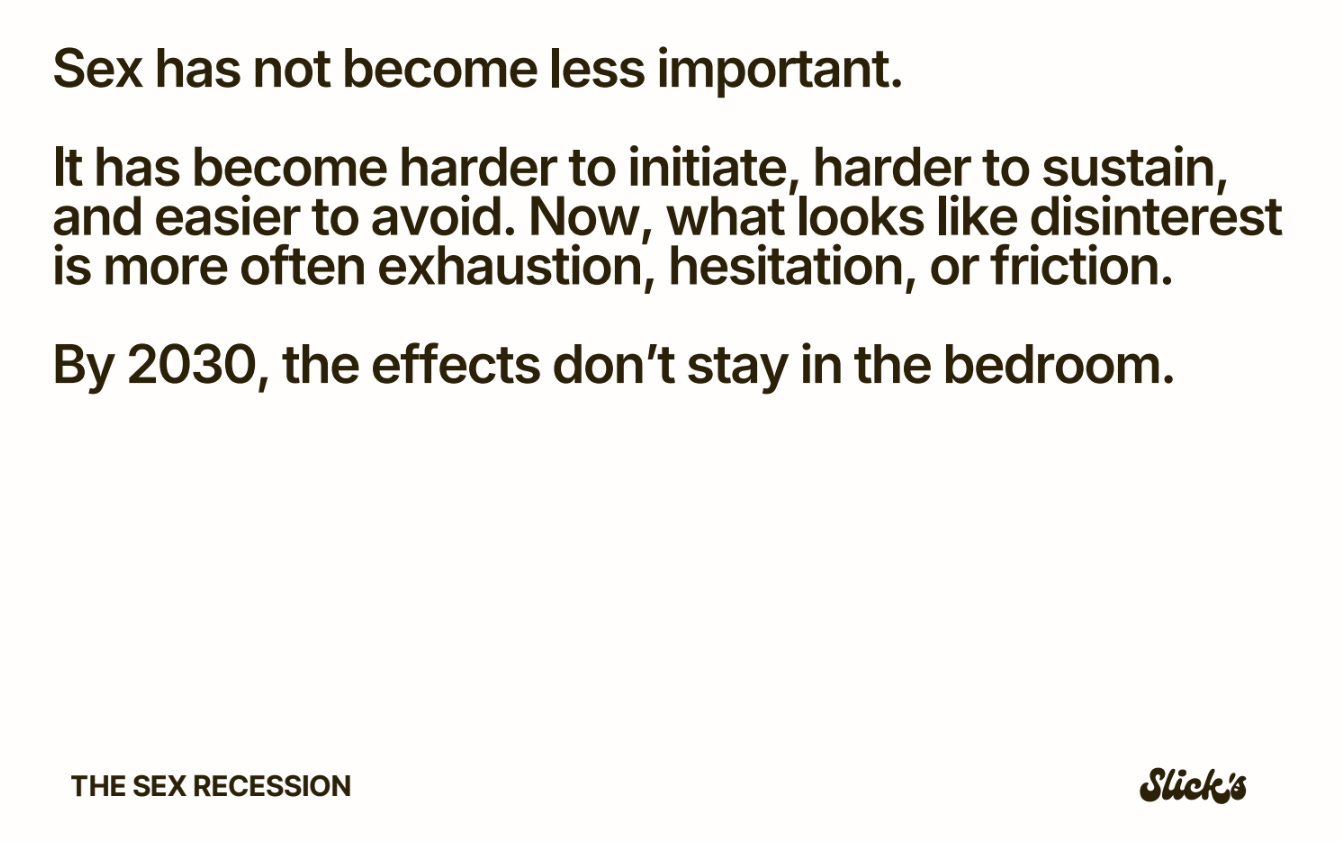
They propose a rather pragmatic perspective forward: “The sex recession is not inevitable. It is structural. And structures can be rebuilt.”
Now, obviously, a singular lube brand isn’t going to reconstruct the foundations of society required to get people to fuck again. But I’m on board with them trying.
There are other brands, though, who are responding to the sex recession a bit differently. This moment represents not an opportunity to fix what ails us but to lean in and profit from the disconnect.
According to new data from Mintel:
39% of all singles are women not dating, compared 25% who are men not dating
13% of single women not dating feel pressure to be in a relationship, compared to 21% of single men not dating
59% of single women not dating in 2025 self-described as independent, compared to 44% of single men not dating
In other words, there is a massive population of single women who have no interest in the romantic narrative. But that doesn’t mean that there isn’t a different narrative they might be willing to buy into. Mintel’s data is geared toward consumer research and market intelligence, informing brands on consumer behaviors: “Brands should represent various experiences in communications and product development, tailoring offerings for those living alone or with roommates,” their 2025 Singles and Socializing report reads. “Offer single-friendly pricing options for traditionally ‘couples’ experiences, such as solo travel packages or subscription dining passes and table-for-one offerings, to address the ‘singles tax.’”
Obviously, there’s nothing wrong with that. Even people in relationships want opportunities to do things alone! There is a way to market to single people that isn’t entirely cynical, just as there is a way to sell a commercialized version of love on Valentine’s Day. But if you take a look around the way the holiday is being navigated by many brands, there is indeed a good deal of cynicism present.
Not to engage in the perpetual culture war fodder that Target somehow provides, but let’s use some of their merchandise as an example. This year, “Galentine’s Day” is featured nearly as prominently as Valentine’s Day, promoting it as a seperate holiday the day prior for single women to enjoy with their friends. And once again, nothing wrong with that as a concept! I want to wear pink and eat candy with my friends!
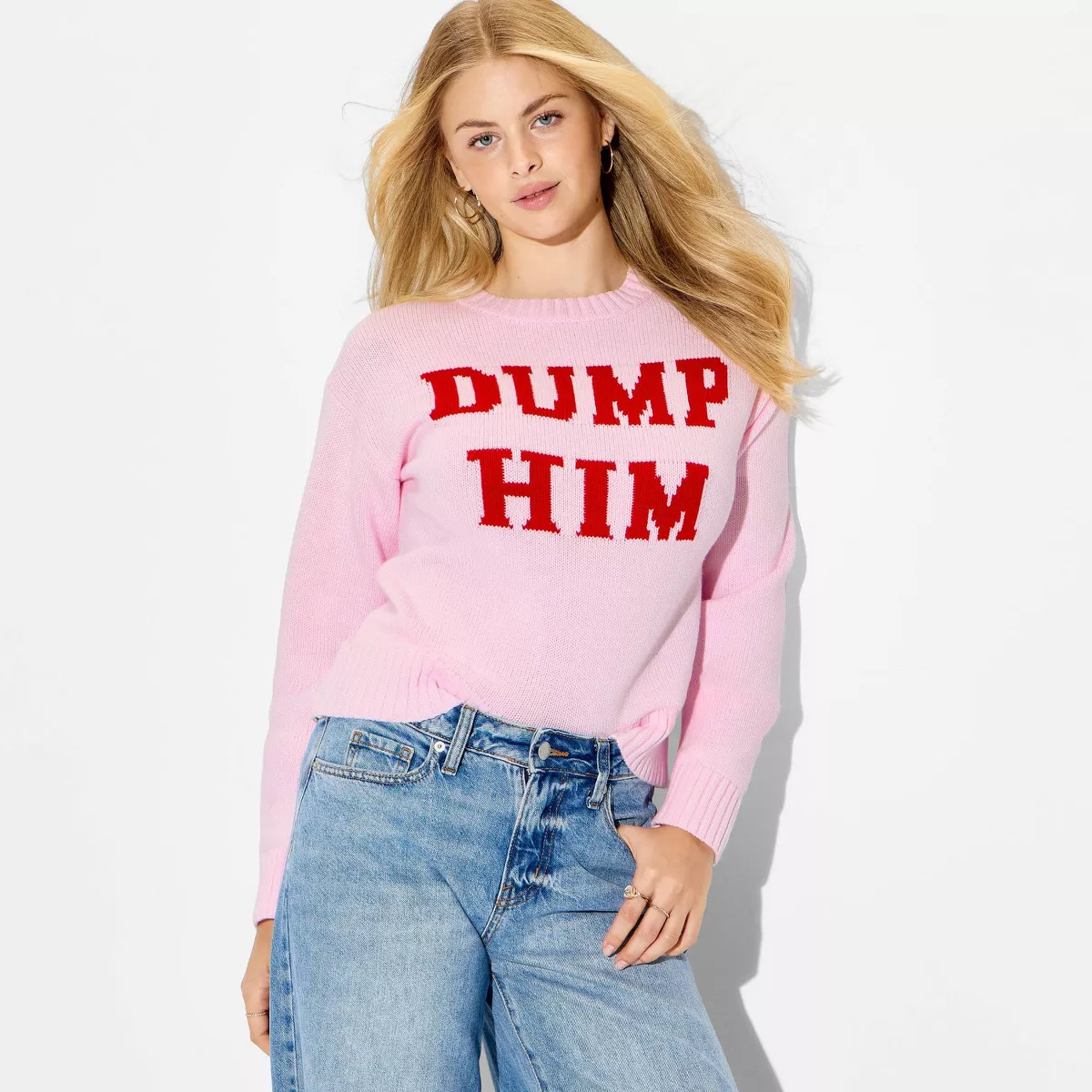
I am, however, suspicious of the selection of merchandise with phrases like “Dump Him” and “Emotionally Unavailable” on them. This sort of thing isn’t new at all — this type of bratty girl power independence was popular in the aughts among teenagers — but I nevertheless find it tackier now that it’s being promoted to adult women. Maybe that is a whole different issue in itself: marketing to teen girls is now the same thing as marketing to adult women, and vice versa. In fact, the “Dump Him” sweater is part of Target’s Wild Fable line, which I believe is technically a juniors brand but has been reorganized into a more general women’s section.
The attitudes and expectations we have of each demographic are now similarly shared, too. In this increasingly single society, more of us are stuck in a perpetual state of arrested development in which we treat the opposite gender as if we’re still only a year or two into puberty.
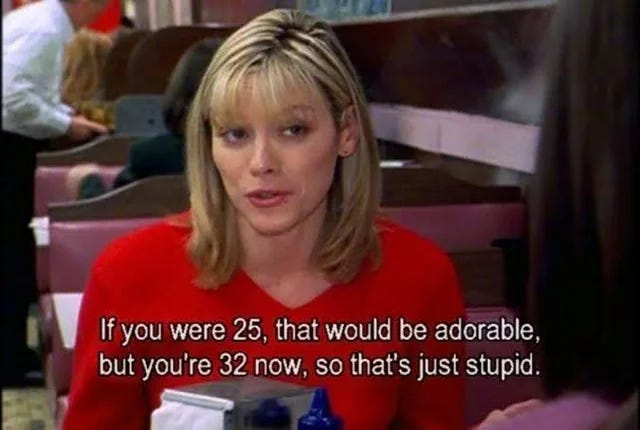
To be clear, going around in a sweater that says “I love my boyfriend” or “Pick Me” would also be deeply embarrassing. For a lot of women, this current wave of anti-man discourse is more broadly and respectably about centering themselves and their friends over men. The “Dump Him” sweater, meanwhile, does not achieve these aims. With this sort of merchandise, you’re still branding yourself around men — just the fact that you don’t like them.
You don’t have to enjoy Valentine’s Day. You don’t have to participate at all. But signalling your aversion through conspicuous consumption at Target, of all places, brings us no closer to happiness. This isn’t some type of empowering normalization. It’s just a cheap shot at making our social apathy profitable.
Target isn’t selling “Dump Her” t-shirts, probably because men are not the market for Valentine’s Day unless they are buying something for someone else. The concept is still nevertheless being marketed to men elsewhere, namely through guys like Andrew Tate and other members of the Manosphere.
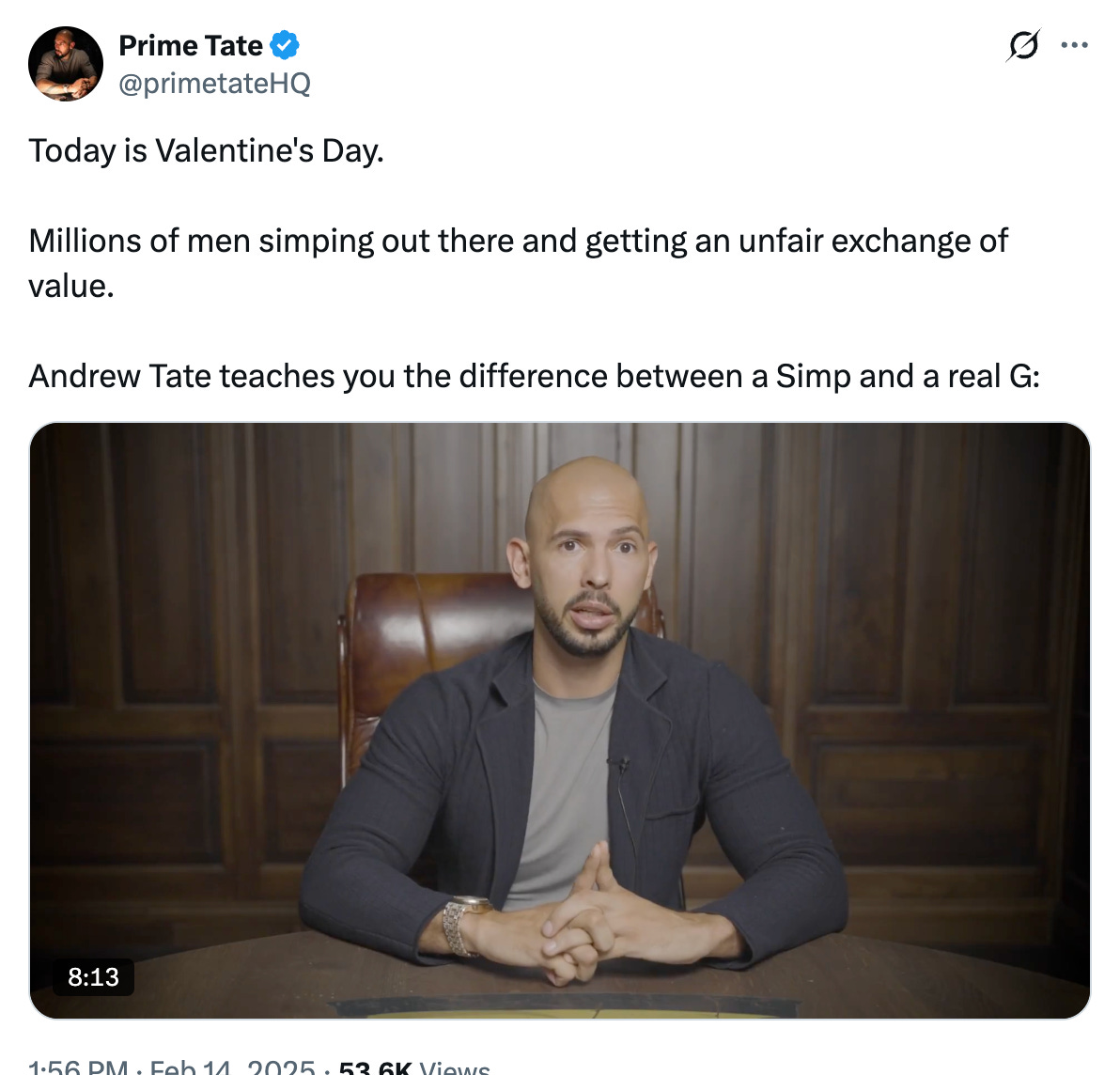
In other words, you can engage with this antagonism endlessly for free (well, monetarily speaking) online. So why are you going to give a corporation $30 on a cheap plastic sweater to do the same? Wouldn’t you rather just buy yourself the damn box of chocolates?
It's not that marketing is targeting the same products to adults and teenagers. Adults and teenagers now have the same interests. Contemporary adults are eternal teenagers.
Sorry if this comment comes off as aimless and long winded haha but this post is coinciding with me seeing someone repost an image on IG yesterday from the deviant art page called Anti-Romance https://www.instagram.com/p/DUjFgOtiQMP/?img_index=3&igsh=MWRjNnU4dnh1ZHd6cA==
Seeing who liked the pic was quite a window into what these people are going to be thinking and feeling this weekend. Though, I can’t really blame them. It’s sad to feel like you’re falling behind on fake deadlines or if your friend has silently disappeared to Boyfriend Island, I feel like the uptick in Galentines marketing caters to these feelings becoming more of a norm.
I have been dating someone for 1.5 years who I (sadly) really believe is perhaps the only person to have ever actually liked me for who I am beneath all the benefits I could provide for them (laughs, pussy, new friends because I have many, etc). The way I described my experiences before him is “being dragged by the ear through the male loneliness epidemic”. Luckily for me, those who used to drag me are more or less exactly where I left them.
I haven’t read the slick link yet, but I can’t help but wonder if these studies are a byproduct of lower sales.. Will check after I press post lol