


Hello and welcome to Many Such Cases.
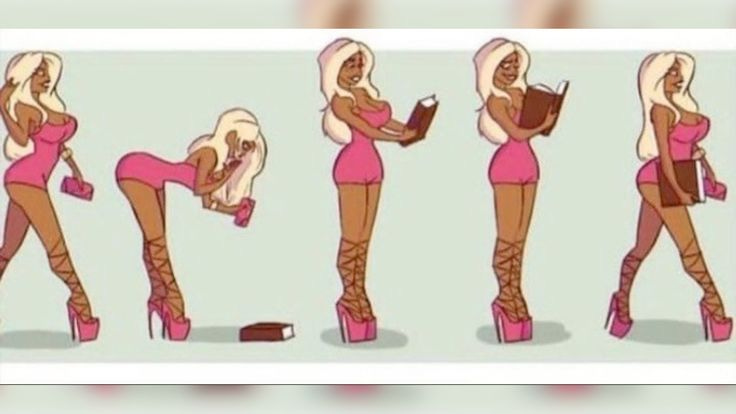
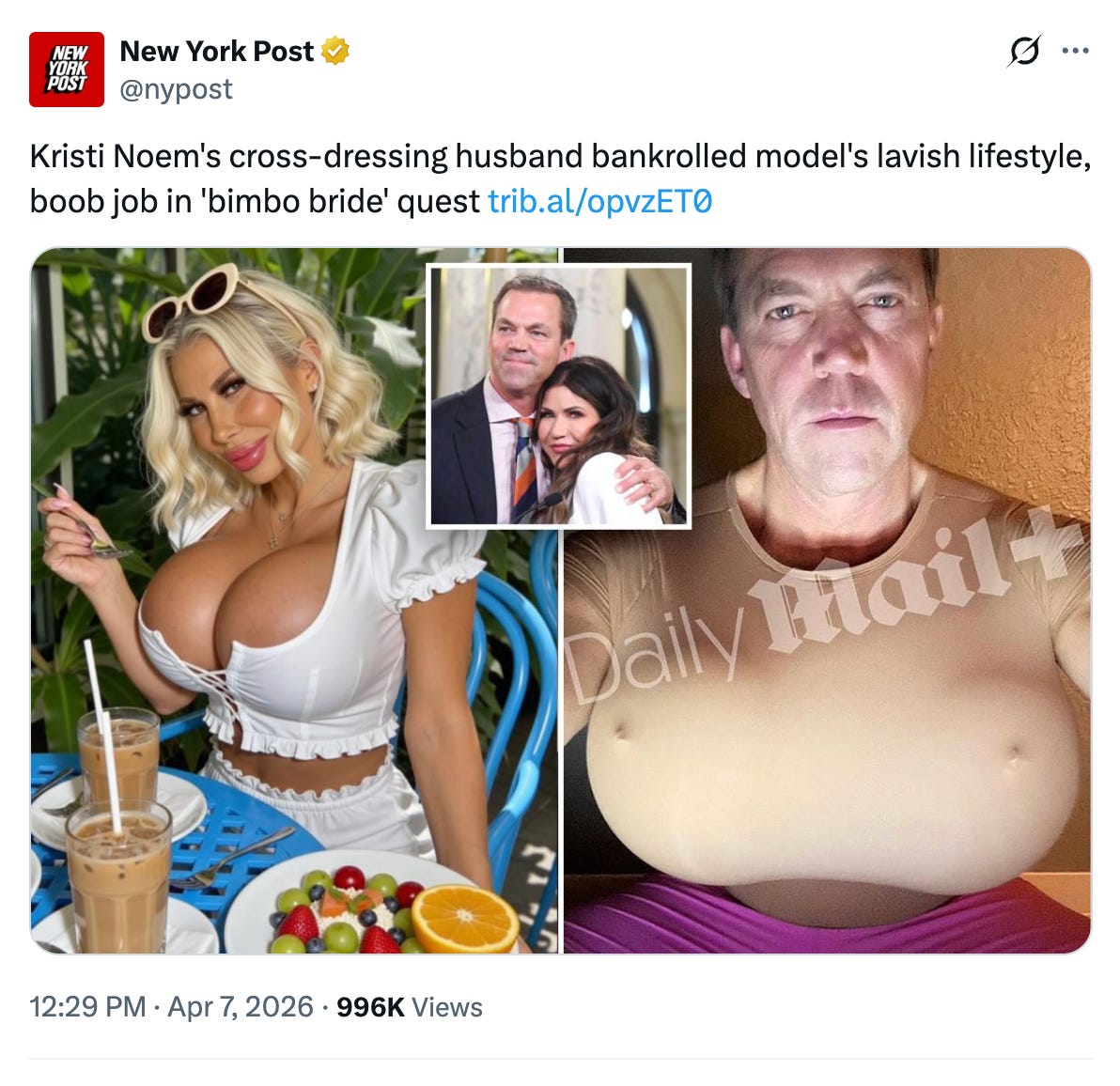
Last week, as you may have heard, former Department of Homeland Security Secretary Kristi Noem’s husband Bryon Noem was revealed to be harboring a fetish for wearing cartoonishly large prosthetic breasts and paying adult performers on the Internet to indulge him in crossdressing. Bryon enjoys the experience of “bimbofication,” a kink in which, yes, one transforms into a bimbo: giant breasts, tight clothes and the mentality of an air-headed woman who loves to be sexy and sexualized.
I don’t find the concept of this man having a bimbofication fetish to be all that surprising. It embodies why I titled this newsletter Many Such Cases to begin with — all those niche and bizarre little instances of sexuality creeping up into the mainstream are in fact far more common and perhaps even mundane than some may anticipate. A conservative, masculine-seeming man in a high-stakes, ultra-visible position has risked his family’s reputation in pursuit of a strange kink? Truly, many such cases.
You may recall an effort in the late 2010s and early 2020s to embrace and “reclaim” the term bimbo. I myself wrote about it several times, interviewing women who had undergone several surgical enhancements to their faces and bodies in order to achieve a Barbie look. Seven years ago, I interviewed Alicia Amira, an independent adult performer who today refers to herself as the “founder of the bimbo movement.” I asked her what it meant to be a bimbo in 2019, and how the label had changed. She responded the following:
“I’ve worked hard to help push people’s understanding and awareness of the immediate ridicule, exclusion and stigma women suffer when they choose to dress hyper-feminine and look like a bimbo. Because a woman who looks like a bimbo is often judged for having poor judgment, lack of intelligence, declining morals, etc.
But a bimbo isn’t a dumb blonde ‘airhead.’ She isn’t just a sex object. She isn’t oblivious to what’s going on in society. And she most certainly isn’t a victim of a fantasy created by men. A bimbo is an intelligent, creative, fun, confident woman who is taking ownership of her own sexuality and refuses to be judged by her looks. It’s an ancient way of thinking that people (generally speaking) still are judging women who dress sexy, wear lots of makeup and look hyper-feminine.
 Tiktok failed to load.
Enable 3rd party cookies or use another browser
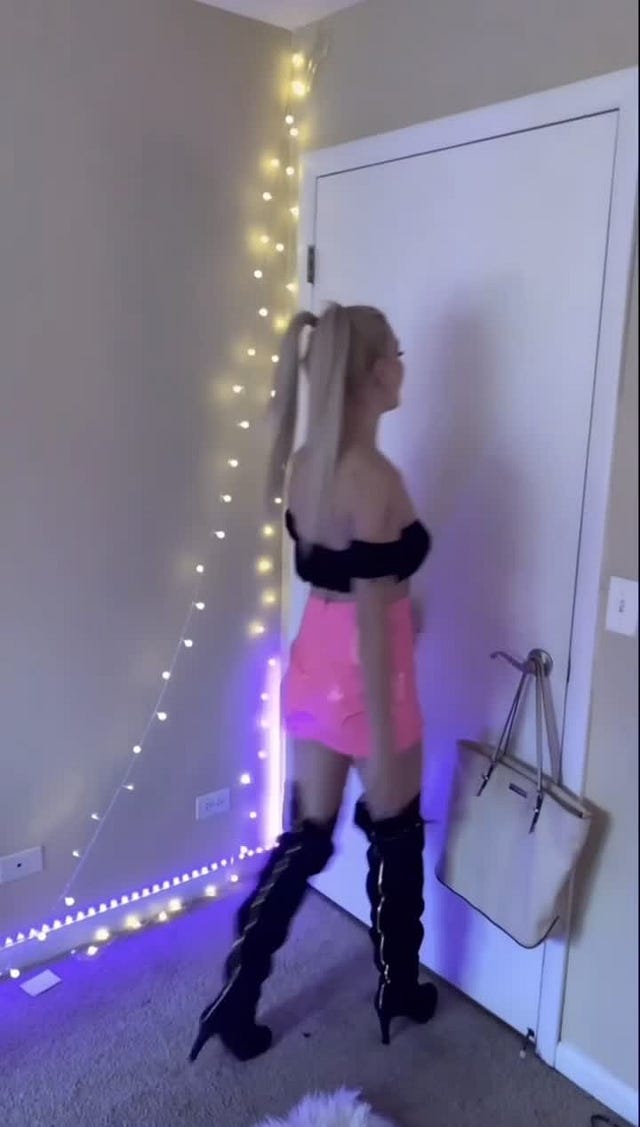
This specific framing of bimbo identity made its way to TikTok, further popularized by women like Chrissy Chlapecka, who grew to prominence for her embrace of blonde hair, tiny pink outfits and talking about leftist politics in a suspiciously soft, high-pitched voice.
“The modern-day bimbo is a fresh approach to intersectional feminism. There is, actually, careful thought behind bimbology, and it could be a way to reach true liberation,” VICE wrote of bimbofication and Chlapecka in 2022. And as my own interview with women like Amira highlights, there was a time when I thought the same could be true, too — that a genuine argument for women’s liberation could be made in our embrace and ownership of hyper-feminine aesthetics.
It takes one look at Bryon Noem to show that dream never quite came to fruition.
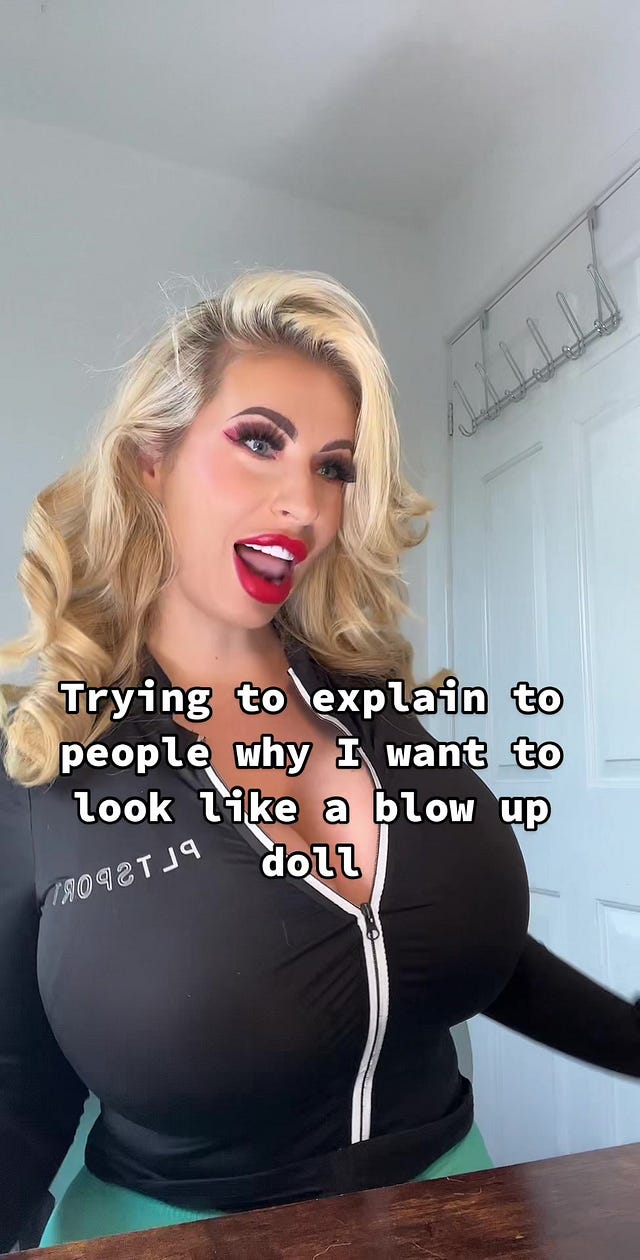
Amira, in the several years since I was last in communication with her, has continued her bimbofication project in the extreme. Her breasts are now at 2100cc’s, her lips inflated to match. On her X account, where she promotes her OnlyFans, there are several clips of her posed like a sex doll, arms fixed at a 90 degree angle. She routinely refers to herself as a plastic toy designed to fulfill men’s desires.
Well and truly, I don’t think there’s anything “wrong” with her enjoyment in and profit from that dynamic on an individual level. I believe her now just as I did in 2019 in her assertion that this is about her own sexual pleasure. That is fine! But it is not “empowerment” for women in any broad sense. It may be personally liberating for her in an explicitly sexual context, freeing herself from past shame or expectations around her own desires. That is still something different from cultural liberation.
The thing is, not everything a woman does is required to be liberating and empowering, particularly as it applies to her own sexual and personal life. It isn’t any one person’s responsibility to consider how their private actions and desires might reflect upon society writ large. It is worth considering how your private actions and desires might themselves be reflections of society writ large, but that is about as much as we can expect. The phrase “the personal is political” has been inverted to describe the sense that our own personal lives are something of political importance, rather than politics impacting our own personal lives. For someone like Bryon Noem, perhaps is personal life is indeed of political importance. Among the rest of us, though, who are not married to administrative ghouls, that’s not quite the story. There is nevertheless a pressure, though, to conduce our lives accordingly. A woman can’t just be a bimbo, she has to justify it. She has to explain why it’s actually really good for her and women writ large. But that is, almost in its definition, not what being a bimbo is about.
 Tiktok failed to load.
Enable 3rd party cookies or use another browser
What defines someone’s own sexual pleasure, moreover, can sometimes be inextricably linked with someone else’s sexual pleasure, too. Such is often the case for the bimbo. A woman who likes to pretend she is a plastic sex doll, I must imagine, likely delights in the idea that her partner is enjoying the concept, too. And again, in the context of one’s individual, private life, there is nothing wrong with that. There might even be a beauty in collapsing oneself momentarily into the desires of another. But just the same, it doesn’t have to be wrapped in a package of feminist empowerment for the sake of public palatability. Not everything needs to be subject to this form of political scrutiny.
Still, many cling to the narrative. After the Noem scandal, self-identified bimbos spoke with reporters about the lifestyle, generating headlines from New York Post such as “‘Bimbos’ hit back at insults as wild Bryon Noem reveal brings kink to light: ‘People assume I’m not smart.’”
And seeing this dynamic unfold again, years after the last bimbo trend cycle, all I can think is, you tried this before. It doesn’t quite seem to have worked. That Bryon Noem even has this fetish is evidence of that. As much as people may want to argue that embracing the bimbo aesthetic is empowering and that it actually has nothing to do with being vapid and unintelligent, the sexual reality of bimboism will always be objectifying. That’s the point. That’s why Bryon Noem is into it — because it allows him to feel like a sex object.
For the women who embrace bimboism either as fetish or just as aesthetic, I am not suggesting at all that they change or feel differently about themselves. Those who take pleasure in the look, sexually or not, should indeed remain personally “empowered” to do so. I am, moreover, not the arbiter of personal empowerment! That is, I think, my broader point. Our claims of personal empowerment are always tied up in a cultural political context, and there is something inherently disempowering in that dynamic. If you want to be a bimbo because it’s fun or sexy or kinky or a creative outlet, you should do it because you want to do it. You don’t have to crouch it in terms of intellectualism and ethical approval. God knows Bryon Noem wasn’t.
Fair and intelligent essay. It made me become a paid subscriber.