


Hello and welcome to Many Such Cases.
There has been no shortage of things to talk about in the last few weeks, or otherwise avoid talking about entirely. The Cornell 7… Shane Gillis’ “joke” about women dressing like “whores” at the gym… it’s as though we are perpetually stuck in 2016. Has anything measurably changed in our sexual culture over the last decade? Events and moments like these leave me to wonder.
Last month, Playboy published our 2026 Gen Z Sex Survey, conducted in partnership with the Kinsey Institute and Julie. The results highlight that yes, materially, physically, we are no longer in 2016. In 2016, the average young adult was having a good deal more sex.
Disparity may be the defining feature of our moment: as The New York Times explained at the tail end of 2025, everything—but especially our economy—has become “K-shaped.” You are either rising to the top, or declining to the bottom. There is no longer a comfortable middle at which to sit. More and more, that lower arm of the K seems to be lengthening, and steeply.
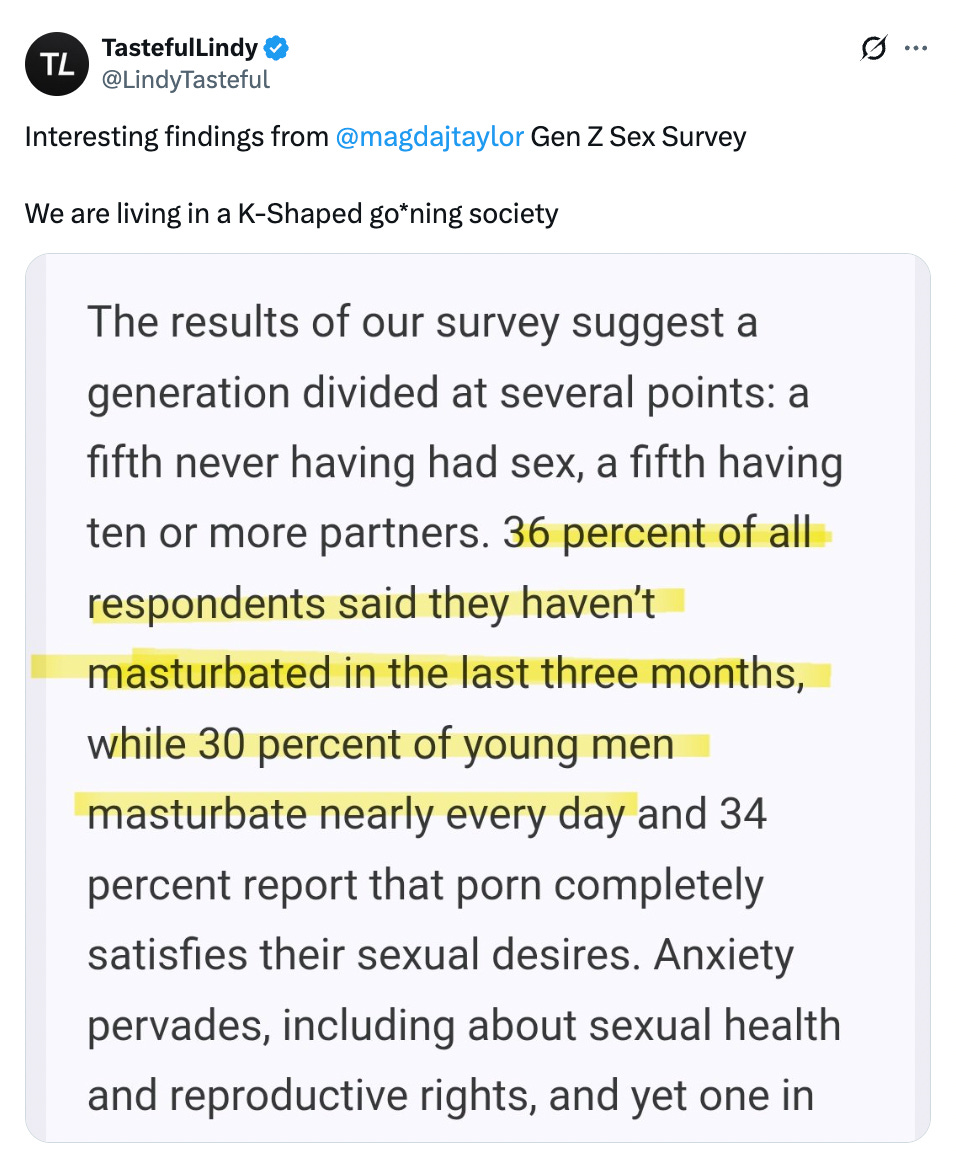
To repeatedly beat the same drum, sex has not escaped this trend. One in five young adults have never had sex, while one in five has also had ten or more partners. There is a widening pool of people at bottom of the sexual rung: living at home with their parents, virgins or at least celibate for more than six months, anxious about themselves and their futures, finding fulfillment in pornography and digital life. Our attitudes toward sex mirror this pattern, too: that’s why this sex recession coincides with an era that so many would describe as outwardly sexual. That’s why women are both wearing form-fitting mini shorts to the gym and also still being called “whores” for it. The polarity and the paradoxicality are the point.
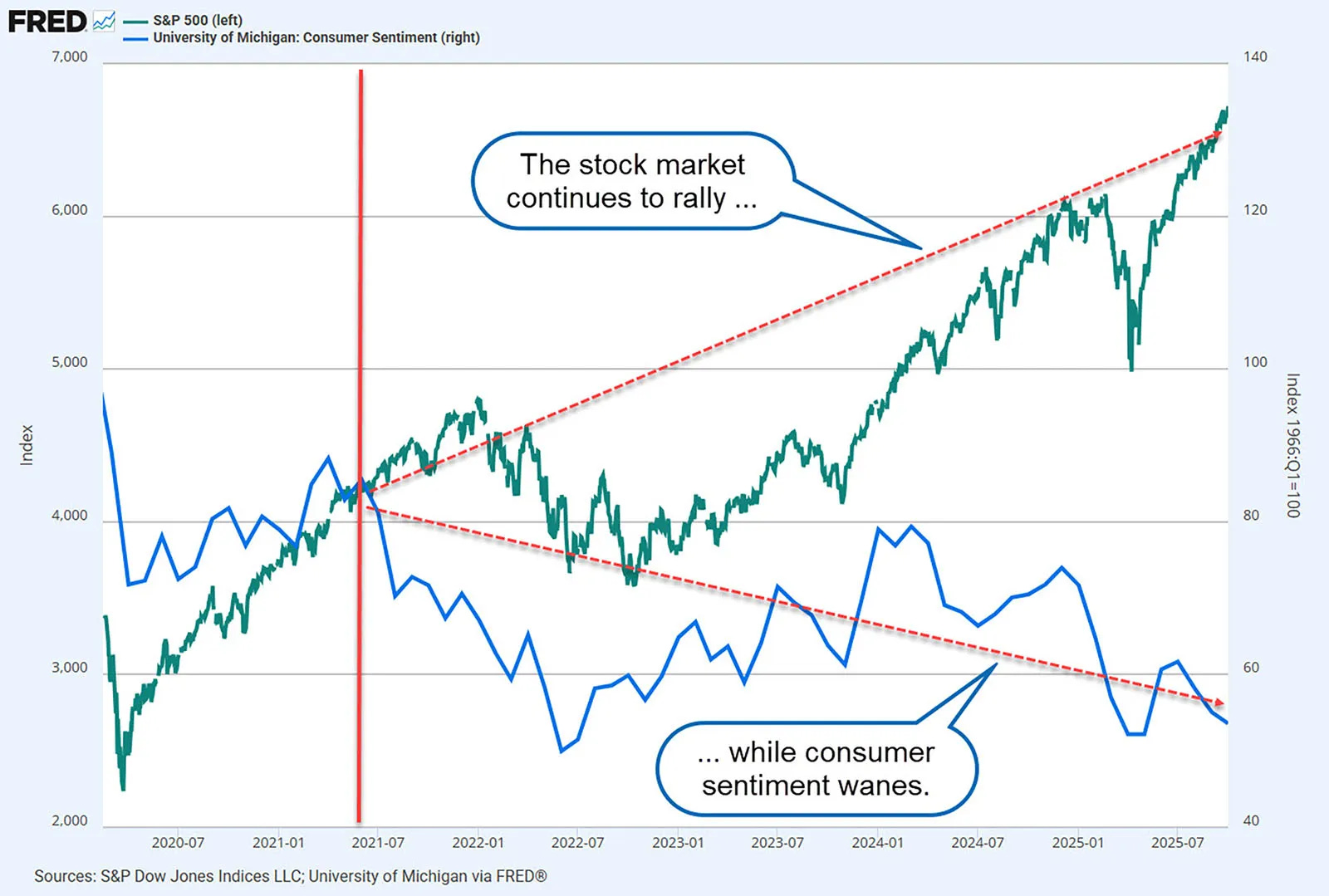
Economically, the K-shape moreover describes the gap between large-sector growth—the stock market, for example—and people’s perception of the economy. In terms of many people’s real, lived, everyday experiences, America’s financial reality is far worse than the S&P 500 would demonstrate. That is apt in understand the sexual economy, too: it looks like we are in a hypersexual world, but that isn’t how the reality actually shakes out.
But unlike the actual economy, most of us do maintain some level of choice in where we might be positioned in this K-shaped sexual economy. Yes, our own sexual appeal and sexual success may often be informed by biology and social standards beyond our control—incels do get some of that right. But we can nevertheless choose how we navigate those standards and our attitudes towards ourselves and others. Sorry! It might be the only thing that stops us from sliding to the bottom of the K, entirely.
My Predictably Cynical Take on Wicker
Wicker debuted this weekend, to a fairly strong critical response and box office performance. On a Tuesday evening a few weeks back, I went to an early screening of the film, hosted by Feeld. Wicker is intended to be a fable, following a fisherwoman (played by Olivia Coleman) who has grown tired of the shame of being single in her village and asks a magical basketweaver to fashion her a husband made of wicker. This wickerman, notably played by the very sexy Alexander Skarsgård, is a powerhouse in both the bedroom and taking on domestic duties—making the fisherwoman much happier than most other women in her village.
With this information behind us, I’d hope no one would expect this film to be a paragon of romantic nuance and interpersonal depth. It is, again, a fable, and relies on a simplistic moral framework as such. But the simplistic moral framework altogether seems to be: being straight is awful, and obviously so. Men and their desires are an annoyance in the best case scenario. The only good man is made of wicker, but if a human man wants a wicker wife, he should probably die.
Wicker is thus a heteropessimistic fairytale, maybe one of the first of its kind. It relies not on the wistful belief in true love but in the defeatism that true love among humans does not really exist.
Still, it’s a movie about a woman who fucks a man made of wicker—and he’s really good in bed. If we are looking to Wicker for guidance on the state of heterosexual relations, we are misguided. I also do think there are some worthwhile themes to glean from the overall message that romantic equity and happiness are the product of mutual intention, and I appreciate the general assertion that sex and desire are good. That is something!
A Note on Cornell 7, and “Sex Scandals”
There is one arena of sexual culture that I do not often wade into, and that is sexual assault. This is a shortcoming of mine, but not one that is unintentional. Sexual assault is about sex, yes, but it is also a bastardization of sex, too. It is its own entity, and one deserving of its own seriousness and consideration that I am hesitant to even attempt to offer. But it is so obviously a part of our sexual culture, at minimum in how heavily it rests on our minds. And that is, I think, one of the separate issues that has emerged from the Cornell 7 narrative: in its wake was a rabid attempt to capitalize on people’s anger on social media, further fueling the gender war. The whole thing ultimately gives sex a bad name. With this in mind, I quite appreciated this essay in The New Yorker by Anahid Nersessian titled “The Toxic Logic Behind the Shaming of Cornell’s Jane Doe,” in which the writer emphasizes a crucial point: that sex itself is not the problem.
“Whenever there’s a sex scandal,” the cultural theorist Lauren Berlant once wrote, “I feel sorry for sex.” What allegedly happened at Cornell was much worse than a sex scandal. It was a sex crime, an outrageous violation of a person’s right to bodily autonomy. It should make us feel even sorrier for sex, because cases like these tempt us to think that sex itself is the problem, a “gross thing” so fundamentally toxic that it can be easily weaponized as an instrument of damage or disgrace. But to think this way is to capitulate to the rapist’s logic. Everyone has a right to sexual safety, and that includes the right to consensual activity and experimentation that does not end in violence or in public shaming. We could teach young people that sex is a fun, gratifying activity that, like driving a car, comes with significant risks, which is why we reserve it for adults who have received a lot of information and training about how to do it right. Instead, we fill their heads with fear and shame, and leave them to act in a void. This is a tragedy, and tragedy is what it begets.
Sexual Puritanism and the End of Casual Sex
I wasn’t familiar with the publication Works in Progress before this week, and really, I’m still not all that familiar with them, now. But I stumbled across an essay this week from writer Aria Schrecker titled “Young puritans” that caught my eye. Here, Schrecker argues against the common theory that the advent of widely available birth control brought about the sexual revolution. That is certainly a part of the free-wheeling attitude that emerged in the 60s, no doubt, but by her assessment, we were already witnessing a rise in premarital sex before then. She posits instead that casual sex is instead the product of a WWII shortage of men, suggesting that a gender imbalance produces more, say, unrestrained attitudes. But now we are back to the pre-war balance, with young men slightly outnumbering women. And with that, there is no need for women to compete with one another with casual sex as a tool.
It’s a neat theory, particularly when we consider how that gender parity in ratio is coupled with gender disparity in economic and educational attainment. There aren’t just more men, there are more men who don’t register as romantically viable. And thus, that K-shape continues.
Men began to outnumber women in 2013, right around the time that smart phone usage and social media apps gained mainstream ubiquity. This is obviously neither causal nor correlated, but an interesting coincidence nonetheless. There are so many theories as to why we’re in the position they’re in—is it the phones? Is it politics? Is it the economy?—and now, the historical gender ratio is yet another to consider in the mix. Our most intimate moments, our inner worlds, our aspirations, all numbers on a graph.