



I write about straight people because it’s what I know. Maybe we have bigger fish to fry. Maybe you have bigger fish to fry. And obviously, not everyone cares at all about straightness. I wouldn’t ask them to. Especially not during Pride Month! The reality nevertheless remains that straight people exist, and that heterosexuality is currently in a state of unrest. It is likely our own fault. I am nevertheless confident that we can fix it.
What even is heterosexuality? It’s a relatively new term, actually. In the early 20th century, it referred specifically to a “abnormal or perverted appetite toward the opposite sex,” which, I guess is probably a more accurate description of how we interpret it at the present.
Straightness really isn’t much of a thing. It’s a mode of functioning in the body, one of the programmed settings of the human act of mating. The same goes for any sexual orientation: these are descriptors that assign a cultural reality to our basic instincts, but they do not otherwise exist in some concrete form. The idea that any of this was even worth talking about only emerged some 150 years ago. But even so, even beyond the construct, the concrete truth remains that men and women have generally been sexually and romantically attracted to each other since our beginning. Heteronormativity and compulsory heterosexuality have indeed influenced us all — that still doesn’t mean the desire is fake. Yet in the tail end of this century and a half, the very premise has fallen apart.
It is no longer relevant to ask “Do men and women even like each other anymore?” The answer is a resounding no. There is far more interest now in litigating exactly why each party is right not to like each other, why this gendered tension is morally correct. The question now is how we got here to this stage of heterosexuality where it seems the only thing left to do is entirely deconstruct. Can men and women still like each other? I am certain that they can. But first we have to get back to a place where anyone is willing to ask.
In Margo’s Got Money Troubles, a college student unexpectedly becomes pregnant after an affair with her professor. “She’s a student. Supposedly a feminist. What message is she sending?” one of Margo’s roommates asks another as they discuss her decision not to terminate her pregnancy.
“Supposedly a feminist. What message is she sending?”
It’s the precise sort of framing we are often pushed to base our lives around. We must interrogate and dissect the public message, the meta narrative of our personal lives. In attempting to liberate ourselves from the psychic oppression of the patriarchy, we’ve positioned ourselves under a new gaze, instead. Either way, our decisions are not our own.
 Tiktok failed to load.
Enable 3rd party cookies or use another browser
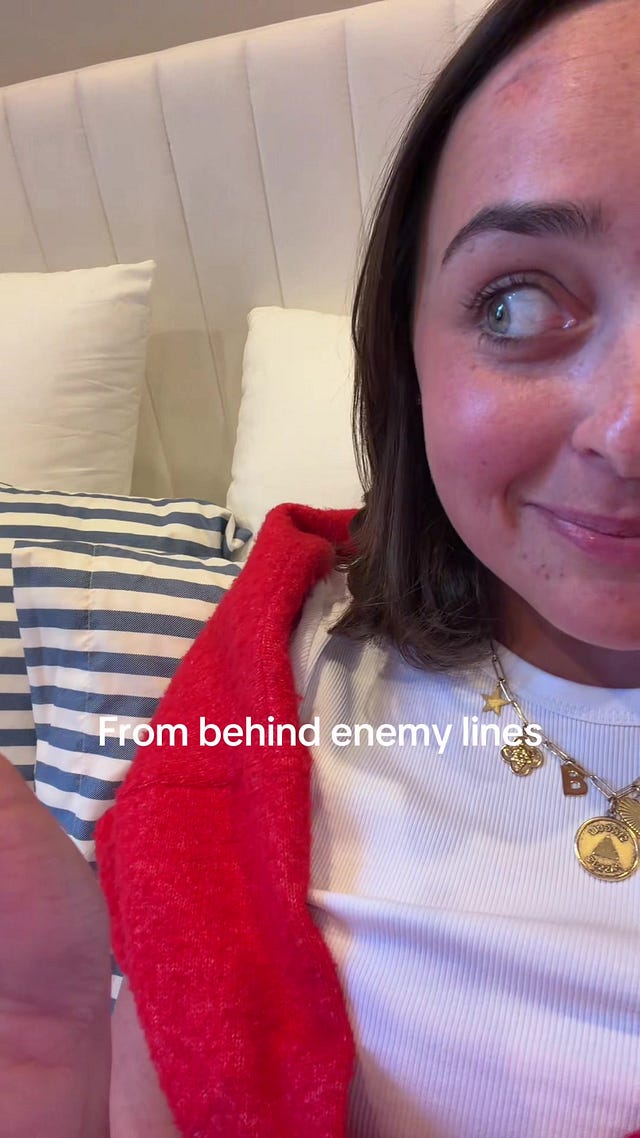
Continuously I see young women online express disappointment in each other when one gets a boyfriend. “From behind enemy lines,” one TikToker wrote as she told her audience she is now in a relationship. “ngl babe I might have to unfollow you,” a commenter wrote, receiving over 100,000 likes. Others commented “ultimate betrayal” and “why am I so hurt.” These are people who ultimately do not know the woman who posted. Some are joking, others are expressing jealousy, but still one message remains clear: aligning yourself with a man, as a woman on the Internet, is going to make some women turn against you.
The idea that women are bad or wrong for wanting men, for wanting to date them or have sex with them or marry them or produce children with them, is misogyny. By definition. It represents a hatred of women based on gender and sex. It implies a belief that a majority of women are dumb and inferior. Do all women inherently want to be with men? Of course not. Do all women have large breasts, or even breasts at all? Again, of course not. Neither straightness nor breast size nor any one thing in particular make a woman a woman. But it would indeed still be misogynistic to discriminate against women who commonly carry a specific trait associated with their gender. It would be misogynistic to assume that a woman has breasts of a certain size due to some sort of internal self-hatred or because she harbors anti-feminist sentiments when in reality, her body may be both a reflection of an innate quality of herself over which she has no natural control or something that she has chosen for herself intentionally.
Heterosexuality as a word, a defined concept, is indeed new. But the sexual desire many men and women share for one another is not just a construct. That people are now experiencing an aversion to one another based on what they’ve seen or personally experienced is also not just a construct, though. It is an entirely natural response. But that doesn’t mean it has to remain uninterrogated. Heterosexuality does not serve everyone, and neither does this animosity.
We don’t yet seem to want to confront the reality that the media we consume, including social media, might influence our political mood. There is a wide scale rejection of the idea that our continuous exposure to heteropessimism might actually be bad for us. And sure, we all know that watching a violent movie doesn’t make us into violent people. But we also know that listening to sad, wistful music can in fact make us feel sad and wistful. We can be brought to tears over a song that has no true connection to our present state.
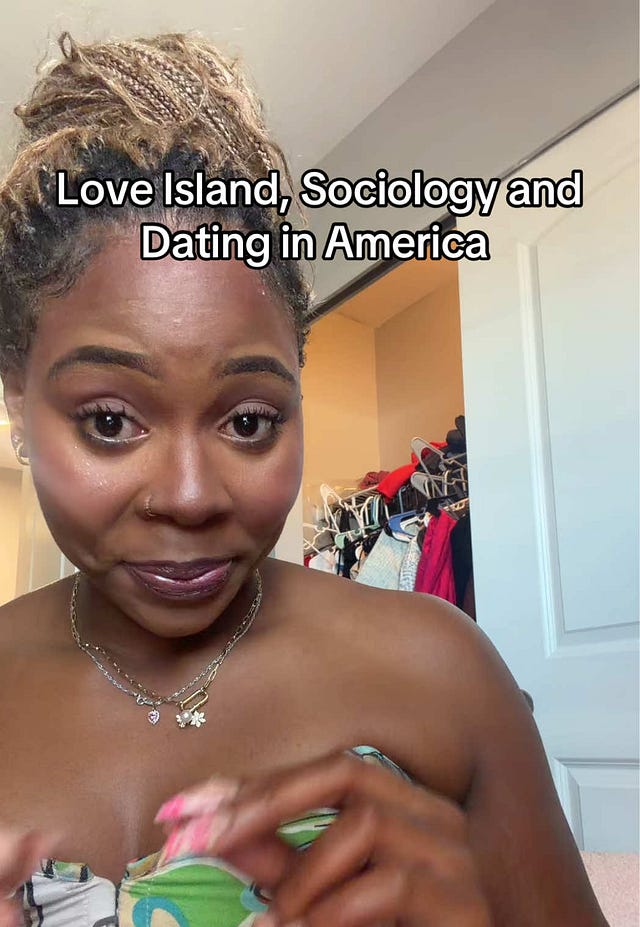
Second to social media, there is one show distilling a set of attitudes towards the state of heterosexuality today: Love Island.
If dating has begun to feel like a full-time job for many, so must watching this show — an hour per day, six days a week. It offers a fantastical view of an almost childishly utopian premise for love. Wouldn’t it be fun if five single women and five single men could enter a Fijian mansion, all makeout with each other, then pair up from that night on for eternity? When a new bombshell enters the villa, they are greeted with loud, wet kisses captured by their ludicrously conspicuous microphones. Every glance at a different person is treated as an ego-shattering betrayal forgotten within fifteen minutes. They’re in bathing suits or clubwear the entirety of the time. They all sleep in the same room. A $100,000 prize sits at the end of the loveboat tunnel. What could go wrong?
It’d be too easy to be cynical about the show. It is so obviously an opportunity for social media-motivated people to pivot into influencing. For whatever they might say about looking for the one, about being ready to settle down and start a family, most of these people are 23. They’re looking for an Instagram sponsorship collab with HelloFresh.
But perhaps such is a reflection of today’s state of affairs. Many of them seem like genuine, fun, beautiful people, even if they are not able to identify where New Hampshire is on a map. They have careers like garbage truck repairman, police officer, digital marketing assistant, nurse. One is an Olympian and the rest hold the abstract title of “model,” but still. They bond and bristle over topics like whether they enjoy eating eggs for breakfast.
Love Island is one of today’s greatest artifacts of straight culture. Heterosexuality is not discussed. In the Love Island universe, that a man and woman couple up is an inevitability. It is a vision of absurd normalcy, tightened and constricted and controlled to the point of becoming uncanny. It is popular because it is both familiar and outrageous at the same time.
 Tiktok failed to load.
Enable 3rd party cookies or use another browser
The phone serves as a constant mediator, even in this fantasy land. Throughout the show, they receive texts on a cellphone — from the host? The producers? A mysterious, abstract Other? — that dictates their direction. The phone tells them what to do, when to sit down, when to throw a wrench in the entire game. They each have their own copy of this phone, but it is fundamentally the same phone psychically connecting them all. Just like in life off the island, their sexual and romantic lives are influenced by a cycle of notifications.
Adding to the intrigue is that beneath the veneer of sophomoric erotic utopia, each cast member is functionally being tortured. They are allowed no contact with the outside world, no clocks, and afforded only four to six hours of sleep per night and a ration of what appears to be only a few sips of wine.
But there is still something refreshingly simple about the show. It assumes constant volatile attraction between men and women. The cast hardly have an identity beyond this. The moment a new person enters the show, the assumption is immediately: all of us of the opposite gender as this person obviously, completely, entirely want to fuck them. Or, at very least, loudly kiss with tongue.
The viewer is, of course, an element of the show themselves. We are watching the antics almost as they occur, with only a one to two day delay. The audience also participates in the show by voting members out and placing bets on the Love Island app. We sow drama and discontent just as much as the producers. We are not narrativizing their dating lives in the past tense, but in real time.
As with all reality television, the core difference between what we see on screen and how the real world functions is that the real world is far more boring and mundane. The generation being depicted in Love Island is not as fun as the one in the villa. They certainly aren’t having as much sex. But besides for this glaring discrepancy, the show does serve as a microcosm for contemporary sex and dating dynamics. On Love Island, the cast lives under constant surveillance and suspicion of one another’s true intentions. They are passionate and horny, yes, but even that may all be just for show.
We’re smart enough to separate reality TV from, well, reality. But what of the fact that this ecosystem of narratives around heterosexuality, be it on Love Island or TikTok, have now come to shape our reality? The contemporary ecosystem of our sexual culture has allowed for little room to address the problems of heterosexuality in good faith. Neither the question of whether we still like each other nor why we definitively don’t are going to deliver us to a place where we can confront the core problem: that we all (straight or otherwise!) deserve to find a way to try and be happy amid these narratives that tell us it’s not possible. The question, then, is how.
Spending the bulk of this essay on parantheticals and disclaimers about being straight is a pretty good bit ngl.
I mean saying "the reality nevertheless remains that straight people exist" sounds just like a Southen preacher calling for the bare minimum of mercy except for the target.
For quite a while now, the only people being celebrated are those coming out of the closet. Gays and trans people are the new heroes. Conventional heterosexual relations, wives, and husbands aren't being praised. Unease at possibly offending someone by admitting an attraction trips up such efforts. As a PH (Post Heterosexual), I feel sorry for young people these days. Too much tension; not enough reward.